
Category: News & Briefs
Anthropic announced an initial $100 million investment in 2026 to launch the Claude Partner Network, a formal channel program intended to move Claude deployments from pilot projects into repeatable enterprise production. The headline is simple, but the technical signal is broader than funding alone. Anthropic is allocating capital to the delivery layer around the model: training, certification, implementation support, partner operations, and execution pathways that reduce time-to-production for organizations that do not want to build everything internally.
In the official announcement and partner materials, Anthropic describes a network model that includes Anthropic Academy training, dedicated technical support, co-marketing resources, a partner portal and services directory, and an initial certification track beginning with Claude Certified Architect, Foundations. It also states that partner membership is free for organizations bringing Claude to market and that support capacity will expand through applied AI engineers and technical architects. Alongside this partner-network launch, Anthropic introduced a code-modernization starter kit positioned around legacy migration and technical-debt-heavy enterprise environments.
The operational meaning of this announcement is that enterprise AI competition is increasingly decided at implementation depth, not only at model quality. Many organizations can already compare benchmark deltas between foundation models. What slows production is usually integration work: identity and access controls, data boundary design, observability, fallback logic, procurement constraints, security review cycles, and long-tail system migration. A scaled partner layer is one way to convert those bottlenecks into standardized delivery motion.
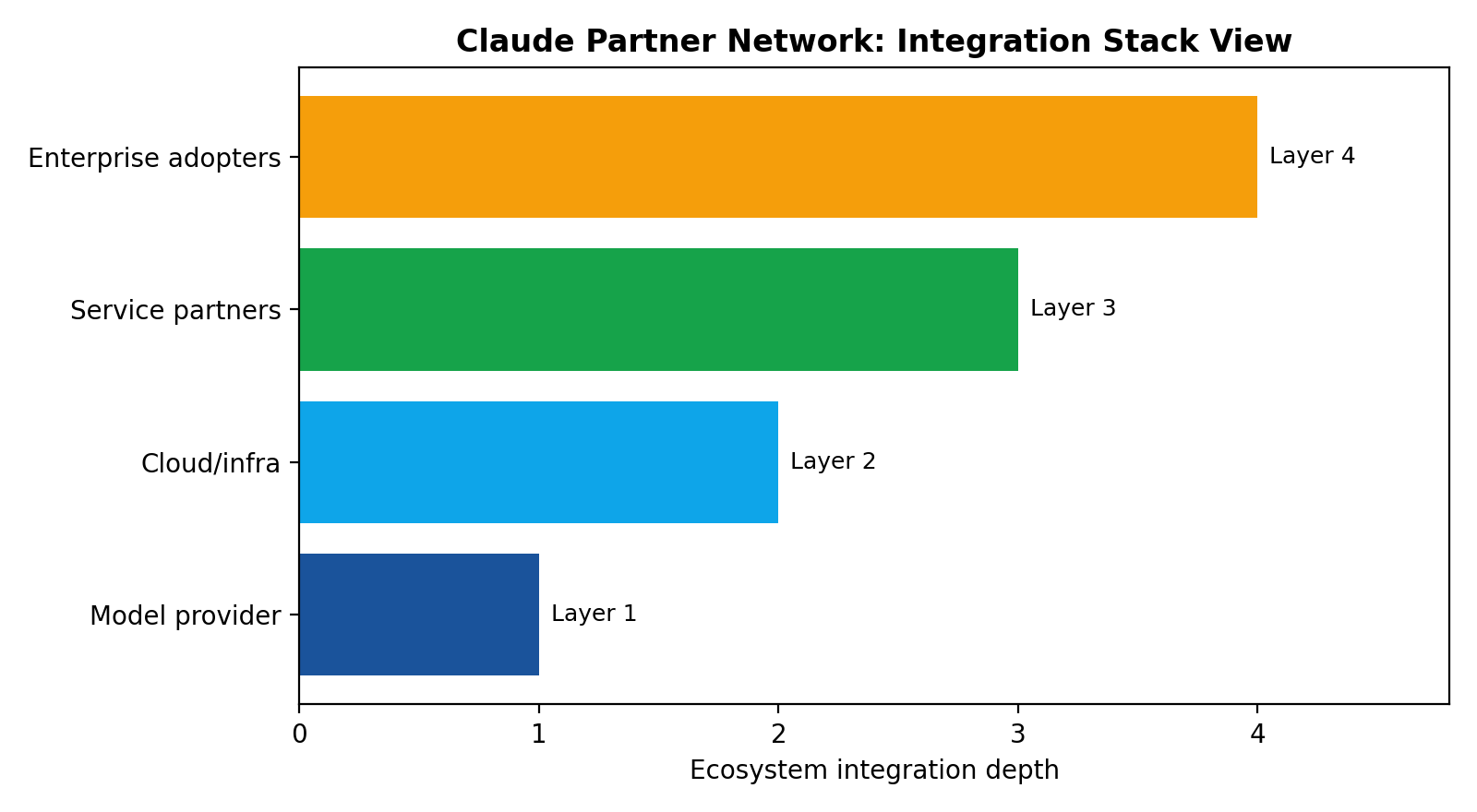
Viewed from an engineering-governance perspective, this is also a stack decision. Teams selecting a model vendor are now selecting an execution ecosystem: cloud channels, delivery partners, certification quality, and support response paths during incidents. A model that is marginally stronger in narrow benchmarks but weaker in deployment support can lose in enterprise selection processes where the dominant variable is implementation reliability under constraints. Anthropic’s move appears designed for that exact decision context.
A second implication is that partner-driven rollouts will likely compress deployment timelines for organizations that already depend on integrators or services firms. The speed gain is not magic; it comes from reusable patterns. Partners that repeatedly deploy the same architecture classes tend to accumulate templates for environment setup, policy controls, testing workflows, runbooks, and governance artifacts. If those assets are mature and verifiable, teams can shift effort away from first-time plumbing and into product-specific differentiation.
That said, partner scaling is not automatically quality scaling. The same mechanism that increases delivery capacity can introduce uneven implementation quality if certification depth is thin or if technical acceptance criteria are loosely enforced. In practice, organizations still need hard gates: traceable security controls, explicit SLO/SLA boundaries, incident ownership definitions, rollback procedures, and evidence that production behavior matches design claims. Capital committed to a partner network increases potential throughput, but outcome quality still depends on governance and execution discipline in real deployments.
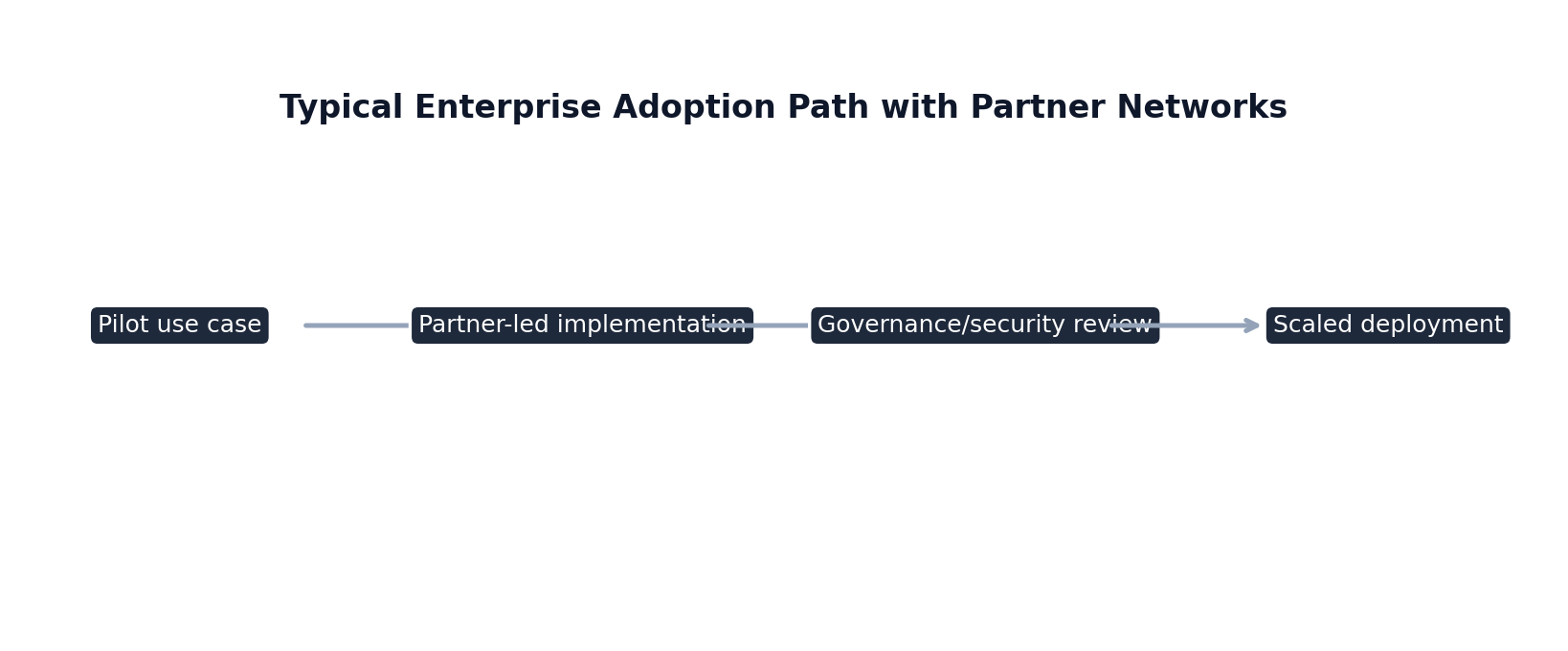
From a market-structure standpoint, the move also reinforces a broader trend: frontier-model providers are converging on ecosystem strategy as a primary moat. The technical core remains essential, but enterprise adoption is increasingly mediated by partner channels, regional implementation capacity, procurement compatibility, and the ability to standardize deployment workflows across heterogeneous customer environments. This is where model providers begin to resemble infrastructure platforms. The shift is gradual, but announcements like this are clear markers of direction.
For teams making architecture decisions now, the practical takeaway is to evaluate partner-network maturity with the same rigor applied to model evaluations. That means checking whether reference implementations are reproducible, whether security and compliance patterns are explicit rather than sales-level, whether integration pathways are documented for your stack, and whether incident support is operationally credible. In other words, the question is no longer only “Which model should we choose?” but “Which delivery ecosystem will let us ship safely, maintainably, and at the pace our business actually requires?”
Anthropic’s $100M commitment does not resolve that question by itself, but it changes the baseline assumptions. It signals a deliberate investment in the enterprise execution layer, where many AI projects have historically stalled. If that investment translates into partner capability that is demonstrably consistent across real deployments, it will materially affect how organizations choose and operationalize Claude over the next deployment cycles.
---
Sources
- Anthropic (official): Anthropic invests $100 million into the Claude Partner Network
https://www.anthropic.com/news/claude-partner-network
- Claude Partners portal (official): Partners | Claude
https://claude.com/partners
- Claude Services Partners (official): Service partners | Claude
https://claude.com/partners/services
- CRN: Anthropic Pours $100 Million Into Claude Partner Network In Channel Push
https://www.crn.com/news/ai/2026/anthropic-s-100-million-claude-partner-network-investment-marks-enterprise-push
- The Next Web: Anthropic commits $100M to Claude Partner Network
https://thenextweb.com/news/anthropic-commits-100m-to-claude-partner-network
- Economic Times (Reuters syndication): Anthropic invests $100 million into Claude AI program
https://economictimes.indiatimes.com/tech/artificial-intelligence/anthropic-invests-100-million-into-claude-ai-program/articleshow/129533940.cms