
Category: Fine-tuning & Alignment
Abstract
Low-Rank Adaptation (LoRA) constrains parameter updates to a low-dimensional subspace by representing each layer update as a rank- factorization. This reduces trainable parameters and optimizer state while preserving much of the performance of full fine-tuning in many practical settings. The central assumption is that task-relevant weight changes are approximately low-rank, or at least concentrated in a few dominant directions. LoRA can be understood as , related to unconstrained full fine-tuning, and analyzed through truncated singular value decomposition. The LoRA scaling factor then controls how strongly that low-rank update changes the frozen base projection. Parameter, memory, and compute scaling laws connect LoRA behavior to spectral properties of gradients and local curvature. The low-rank assumption needs more capacity under large distribution shift, strongly compositional transformations, multimodal fusion demands, and layers that are under-ranked relative to their intrinsic adaptation dimension. Practical diagnostics include singular value decay of update surrogates, layerwise sensitivity probing, and validation loss under rank sweeps. A numeric example based on 7B-scale transformer dimensions illustrates concrete trade-offs for . The conclusion is operational: LoRA works best as a rank budget allocation problem over layers and tasks, with escalation toward broader fine-tuning when the measured adaptation dimension is high.
LoRA Formulation
Consider a pretrained parameter matrix . Full fine-tuning learns an unconstrained update so that
For a linear transform , full adaptation modifies the output by
LoRA constrains to rank at most :
with
A common parameterization scales the update by :
where controls effective update magnitude. Typical initialization sets to zero and random (or vice versa), ensuring the initial forward pass matches the base model.
For a transformer layer with projections , LoRA is often applied to a subset, frequently and , sometimes all attention and MLP projections.
LoRA Scaling Factor and Rank
The LoRA scaling factor is the multiplier applied to the adapter product . Rank controls how many independent update directions the adapter can express. The hyperparameter controls the effective magnitude of those directions after the low-rank product is added to the frozen base weight.
This separation matters during tuning. Increasing expands adapter capacity, while changing changes update strength. At fixed , larger ranks reduce the per-direction multiplier ; at fixed , larger gives the adapter a stronger effect on the layer output.
| Rank | Scaling factor | Practical meaning | |
|---|---|---|---|
| 8 | 16 | 2.0 | Small adapter with strong per-rank update. |
| 16 | 16 | 1.0 | More directions with moderate scale. |
| 32 | 16 | 0.5 | Higher capacity with softer per-direction updates. |
| 64 | 128 | 2.0 | Large adapter with intentionally strong update. |
Rank sweeps should therefore track , , learning rate, target modules, and validation behavior together. A weak result at may indicate insufficient rank, an underscaled adapter, poor module placement, or an unstable optimizer setting. The diagnostic signal comes from the curve: if validation loss keeps improving with rank, capacity is limiting; if loss oscillates or degrades at higher , update scale is too aggressive for the task.
Relation to Full Fine-Tuning as a Constrained Optimization
Let be the downstream loss. Full fine-tuning solves
LoRA solves the constrained problem
which is equivalent to minimizing over in the nonconvex set
Hence LoRA can be interpreted as projecting adaptation onto a low-dimensional matrix manifold. The optimization is nonconvex in , but the effective degrees of freedom are drastically reduced.
Parameter Count and State Complexity
For one matrix :
- Full fine-tuning trainable parameters: .
- LoRA trainable parameters: .
Reduction factor:
When ,
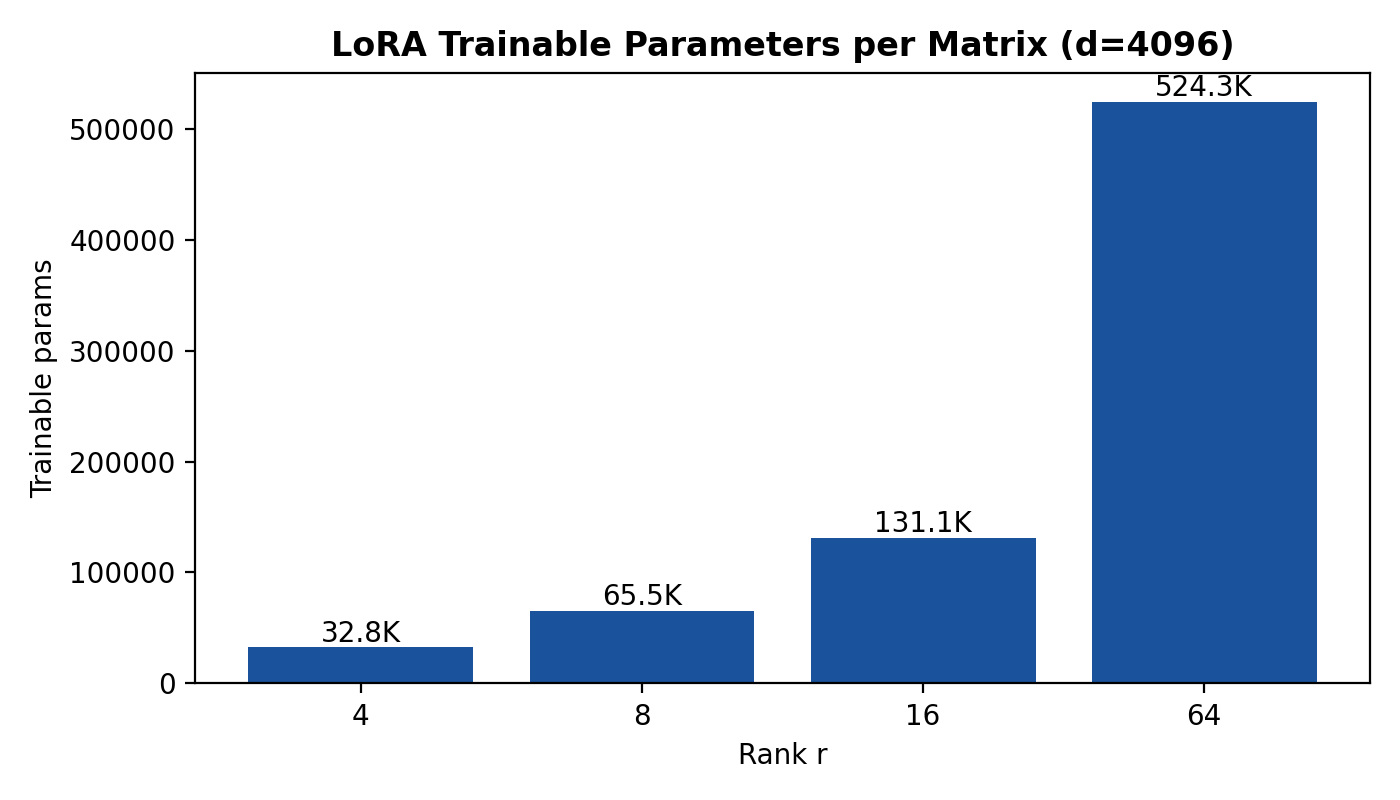
For , this is at , at , at , and at .
Memory savings are larger than parameter savings because full fine-tuning with Adam-like optimizers stores parameters, gradients, and two moments. Ignoring activation checkpointing details and assuming bf16 weights + fp32 moments, trainable-state memory scales roughly linearly with trainable parameter count. Thus LoRA yields approximately the same multiplicative reduction in optimizer-state memory as in trainable parameters.
Forward/Backward Compute Overhead
At inference, if LoRA is merged into , no additional matrix multiplications are needed. Without merge, per token a linear layer computes
Extra cost is approximately
multiply-add units, versus for the base projection. Relative overhead:
For square , , usually small for .
Training compute is subtler: forward/backward through frozen remains, but gradient updates are computed only for . This removes full-weight optimizer updates and moment maintenance, reducing step cost and significantly reducing memory bandwidth pressure.
Why Low-Rank Can Work
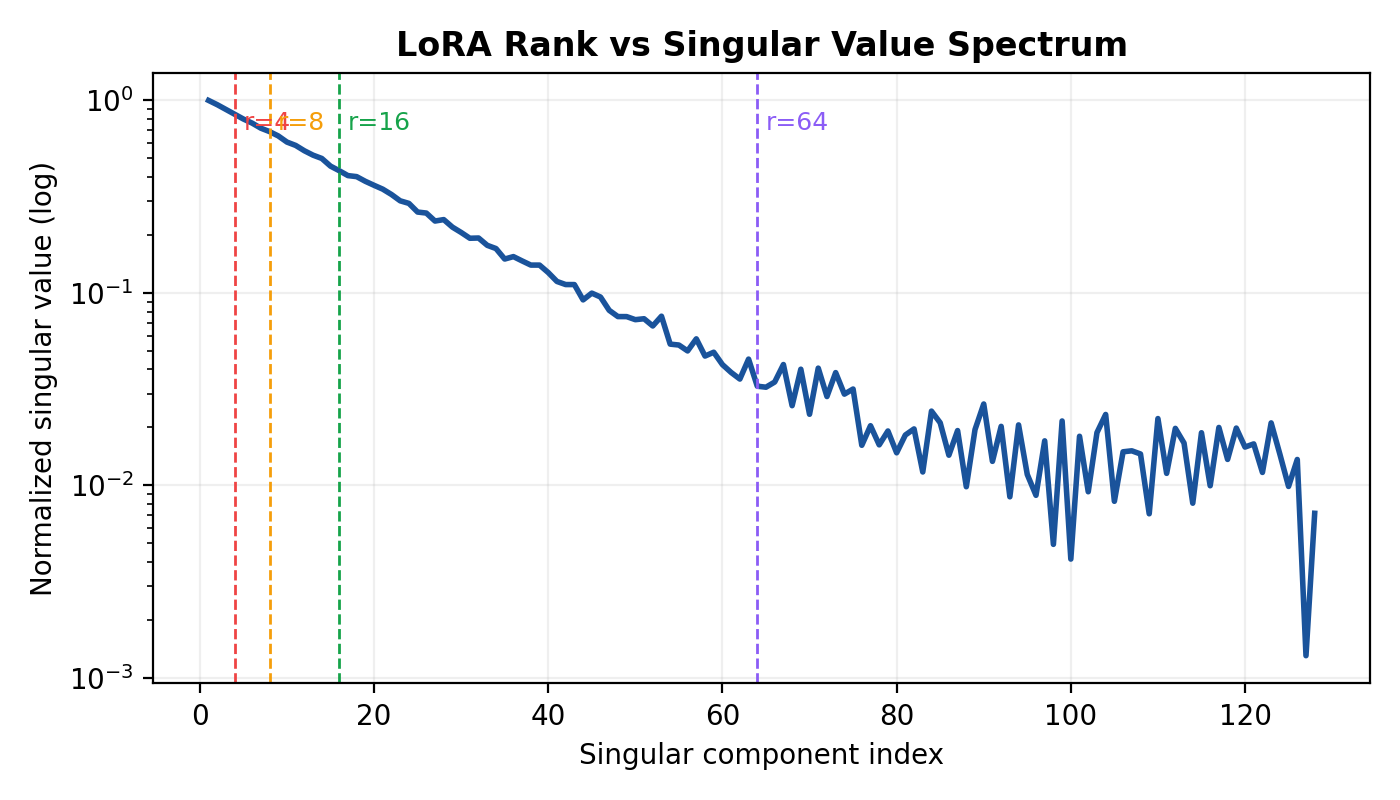
LoRA’s success depends on an empirical rank-deficiency hypothesis: the task-induced update that full fine-tuning would learn has most of its energy in a low-dimensional subspace.
Spectral View of Updates
Suppose the full optimum update for a layer has SVD
If decays rapidly, rank- truncation
captures most Frobenius energy:
Then constraining to imposes limited bias.
First-Order Gradient Subspace Argument
Locally, a gradient step gives
If is approximately low-rank, then a low-rank adapter can represent the dominant descent directions. Empirically, gradients in overparameterized transformers often exhibit anisotropy: a few singular directions carry much of the norm, especially for task-specific heads and middle/upper attention blocks.
Curvature and Effective Dimension
Under second-order expansion around :
where is a Hessian (or block Hessian approximation). If large curvature directions align with a low-dimensional subspace that also overlaps with task gradient directions, adaptation is effectively low-dimensional. In that regime, adding parameters outside this subspace yields diminishing returns.
Task Similarity and Localized Adaptation
LoRA tends to work when:
- Downstream task is near pretraining manifold. Required representation shifts are incremental.
- Adaptation is localized. Only certain layers/projections need modification.
- Loss landscape is smooth near \(W_0\). Small, structured updates suffice.
- Prompt format and token statistics are familiar. Distribution support overlap reduces need for broad reconfiguration.
In these settings, full fine-tuning may spend many parameters modeling weak corrections that contribute little to validation error relative to a compact low-rank update.
Error Analysis
Best Rank- Approximation Bound
By Eckart–Young–Mirsky, the best rank- approximation in Frobenius norm is truncated SVD:
with error
In spectral norm:
This quantifies the approximation bias induced by rank restriction.
Translating Parameter Error to Loss Gap
Assume is -Lipschitz in . Then
This upper bound is loose but operationally useful: if singular tail energy decays rapidly, the loss penalty for low-rank truncation is bounded tightly.
Under a strongly convex local model with curvature , one also gets a lower relation between excess loss and parameter error:
Hence both curvature and spectral tail jointly determine practical impact.
Multi-Layer Allocation
For layer , let singular values of full update be . With per-layer rank , total truncation error is approximately
Given rank budget , optimal allocation places rank where marginal tail reduction is largest:
This formalizes why uniform rank across layers can be suboptimal.
Numeric Example: 7B-Scale Dimensions
Use representative dimensions , MLP expansion , 32 layers.
Per matrix trainable counts:
- Attention projection : full .
- MLP up projection : full .
- MLP down projection : full .
LoRA counts:
So for : . For : .
Concrete values:
| Matrix | Full FT | ||||
|---|---|---|---|---|---|
| Attn | 16,777,216 | 32,768 | 65,536 | 131,072 | 524,288 |
| MLP | 45,088,768 | 60,416 | 120,832 | 241,664 | 966,656 |
Relative to full FT:
- Attention matrix: .
- MLP matrix: .
If LoRA is attached to and only (two matrices per layer):
Across 32 layers:
Thus total trainables are:
- : 2,097,152
- : 4,194,304
- : 8,388,608
- : 33,554,432
These counts are far below full-model fine-tuning scales, explaining why LoRA enables adaptation on limited hardware.
Where Low-Rank Adaptation Needs More Capacity
The low-rank constraint needs more capacity when the intrinsic update rank is high or when rank is misallocated.
1. Large Distribution Shift
If downstream data distribution differs strongly from pretraining , many features must be reconfigured. In language modeling terms, token co-occurrence, style, syntax, and long-range dependencies may all shift simultaneously. The resulting often has slower spectral decay, increasing .
Observable symptoms:
- Validation loss plateaus early for small .
- Increasing yields monotonic, substantial gains up to high ranks.
- Layerwise gradient spectra become flatter.
2. Compositional or Multi-Skill Tasks
Tasks requiring simultaneous acquisition of several independent transformations (e.g., domain transfer + strict formatting + tool-grounded reasoning + style constraints) can induce near-additive update components. If these components lie in distinct subspaces, required rank grows roughly with number of independent factors.
Formally, if
with weakly aligned singular spaces, effective rank can approach . Under-ranked LoRA then forces interference between components.
3. Multimodal Adapters and Cross-Modal Alignment
In multimodal systems, adaptation may need to couple heterogeneous feature spaces (text, vision, audio). Cross-modal projections can require richer transformations than low-rank perturbations around a language-pretrained prior. If modality alignment errors are distributed across many channels, low bottlenecks information routing.
This is often pronounced in projection layers bridging modality encoders to LLM token space, where singular spectra of optimal updates decay slowly.
4. Under-Ranked Critical Attention Layers
Layers differ in rank efficiency. Early layers may encode lexical priors, middle layers relational composition, and late layers task decoding behavior. High-sensitivity layers with insufficient rank can degrade global performance disproportionately.
A frequent mistake is uniform across all target matrices. Under-ranked or specific mid-depth blocks can become bottlenecks even when total rank budget is high.
5. Long-Context and Retrieval-Heavy Regimes
Tasks requiring robust behavior over long contexts can demand coordinated changes to positional interaction patterns and attention routing across heads. These changes often require rank across multiple projections, especially when context-length extrapolation differs from pretraining conditions.
6. Alignment Under Strict Behavioral Constraints
Preference optimization or safety alignment sometimes imposes many small directional constraints across diverse prompts. If constraints are widespread rather than concentrated, low-rank adapters may satisfy some behaviors while regressing others, indicating insufficient adaptation dimension.
Diagnostics in Practice
Robust LoRA deployment benefits from direct measurement rather than fixed defaults.
1. Singular Value Decay Probing
Approximate update spectrum per layer using one of:
- Short full-FT pilot (few hundred steps), then SVD of .
- Accumulated gradient covariance surrogate.
- Low-rank Hessian-informed approximations (e.g., top eigenpairs + projected gradients).
Compute cumulative energy curve:
Layers where saturates quickly are LoRA-friendly; slow saturation indicates higher needed rank.
2. Layerwise Sensitivity Analysis
Estimate effect of adapting each layer alone at fixed rank:
- Insert LoRA in one layer , freeze others.
- Train for short budget.
- Measure validation improvement .
This yields a priority ordering for rank allocation. A stronger variant computes marginal gains when adding rank increments to each layer:
Allocate ranks greedily by largest .
3. Validation Loss Rank Sweep
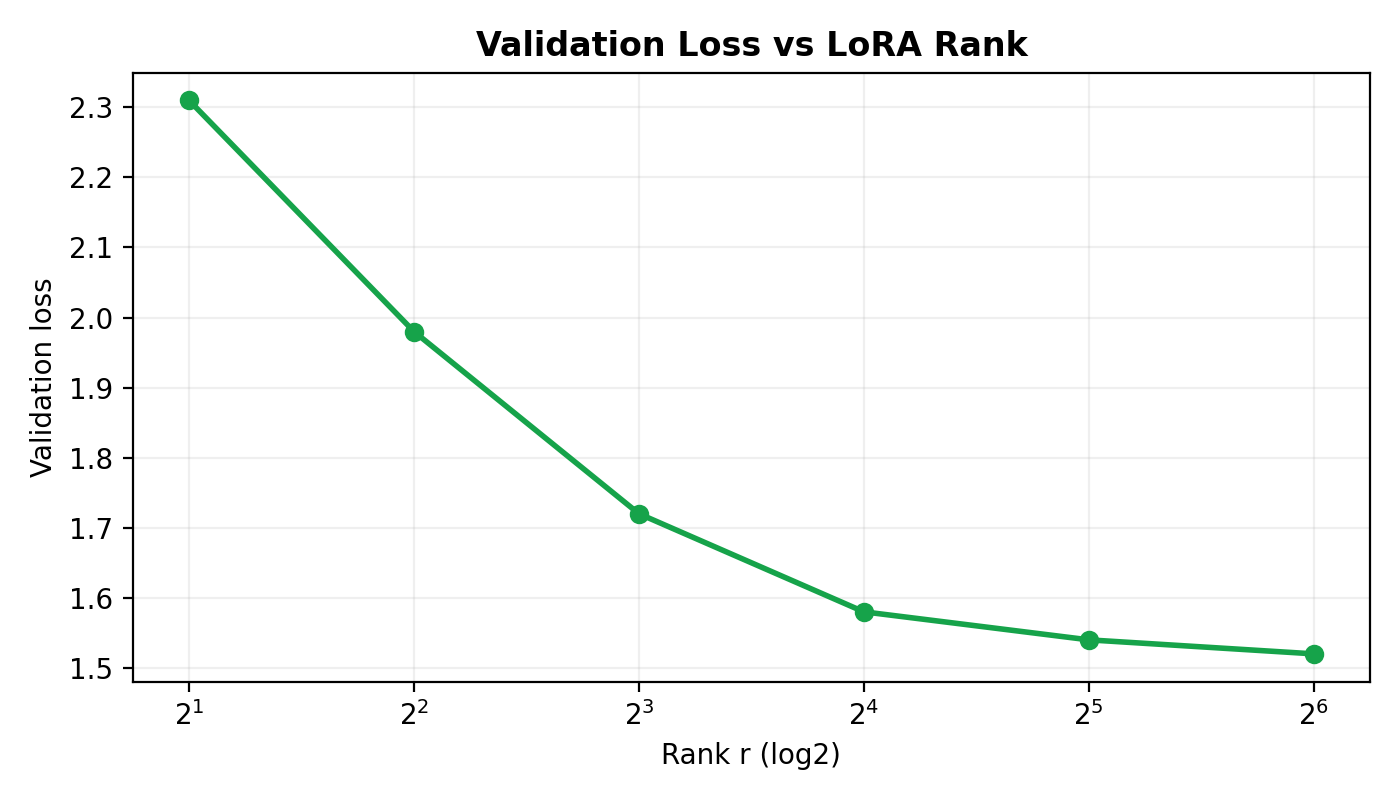
Run controlled experiments for , fixed data order and hyperparameters. Typical patterns:
- Fast saturation: minimal gain beyond or , indicating low intrinsic rank.
- Gradual decline: gains persist to , indicating moderate/high intrinsic rank.
- Noisy or unstable: optimization issues (learning rate, scaling , adapter placement).
Track both in-domain and shifted validation sets. A rank that appears sufficient in-domain may underperform under shift.
4. Gradient-Subspace Overlap Metric
Given top singular vectors of pilot update , monitor overlap with ongoing gradients:
Low suggests adapter subspace is misaligned with current descent directions; rank or placement may need adjustment.
5. Residual Error Audits
If occasional full-FT checkpoints are feasible, compare LoRA-implied update to unconstrained update via
Large pinpoints layers where low-rank bias is dominant.
Rank Selection Strategy
Rank selection is a constrained optimization problem under memory and latency budgets.
Step 1: Define Budget and Targets
Let memory budget permit total trainable parameters . For layer set :
Define target metrics (e.g., perplexity, exact match, reward score) and robustness set under distribution shift.
Step 2: Start with Non-Uniform Prior
Instead of uniform , initialize with heuristic weights:
- Higher rank for middle/upper attention blocks.
- Moderate rank for and MLP down projections when generation control is important.
- Lower rank in layers with historically low sensitivity.
A simple prior:
where is sensitivity score from pilot runs.
Step 3: Coarse-to-Fine Sweep
- Global sweep with shared .
- Choose smallest within tolerance of best validation.
- Redistribute rank layerwise around this budget using marginal-gain diagnostics.
Step 4: Regularization and Stability Controls
High rank increases capacity and overfitting risk, especially for small datasets. Apply:
- Adapter dropout.
- Weight decay on .
- Early stopping on shifted validation.
- Conservative scaling to avoid unstable large updates.
Step 5: Decide Escalation Path
If diagnostics indicate persistent high truncation error, escalate in order:
- Increase rank in identified bottleneck layers.
- Expand adapter placement (add , MLP projections).
- Consider hybrid PEFT (LoRA + selective unfrozen biases/norms).
- Move to partial or full fine-tuning when low-rank bias remains dominant.
Worked End-to-End Budget Example
Assume 7B model, LoRA on and across 32 layers. Per-layer parameters: . Total: .
Suppose budget is 10M trainable parameters. Then
Feasible uniform choices: (8.39M params) or if implementation allows arbitrary rank.
If sweep yields validation losses:
- : 2.31
- : 2.24
- : 2.20
- : 2.18
The gain from is small relative to 4x parameter increase. Under 10M budget, is efficient. Remaining headroom (about 1.6M params) can be assigned non-uniformly: for example, increase rank to 32 in top-8 sensitive layers while keeping others at 16, often outperforming uniform .
Conclusion
LoRA is a principled low-rank constraint on fine-tuning updates. Its effectiveness follows from a spectral property: many downstream adaptations concentrate in a low-dimensional subspace around pretrained weights. When singular values of the required update decay quickly, rank-limited adapters recover most of full fine-tuning performance at a small fraction of parameter and optimizer-state cost.
The same framework clarifies capacity limits. When adaptation demands are distributed across many independent directions—under strong distribution shift, compositional objectives, multimodal coupling, or mis-ranked critical layers—the singular tail is substantial and low-rank bias becomes performance-limiting. In these regimes, uniform low ranks can produce brittle behavior and incomplete alignment.
Operationally, rank should be selected by measurement: spectral decay probes, layerwise sensitivity, and validation rank sweeps. The practical objective is efficient allocation of adaptation dimension under compute and memory constraints. Treating LoRA as a rank-budget optimization problem provides a reliable path to deciding when low-rank adaptation is sufficient and when escalation toward broader fine-tuning is necessary.
References
- Hu, E. J., Shen, Y., Wallis, P., Allen-Zhu, Z., Li, Y., Wang, S., Wang, L., & Chen, W. (2021). *LoRA: Low-Rank Adaptation of Large Language Models*. arXiv:2106.09685.
- Aghajanyan, A., Zettlemoyer, L., & Gupta, S. (2020). *Intrinsic Dimensionality Explains the Effectiveness of Language Model Fine-Tuning*. arXiv:2012.13255.
- Li, X. L., & Liang, P. (2021). *Prefix-Tuning: Optimizing Continuous Prompts for Generation*. ACL.
- Lester, B., Al-Rfou, R., & Constant, N. (2021). *The Power of Scale for Parameter-Efficient Prompt Tuning*. EMNLP.
- Dettmers, T., Pagnoni, A., Holtzman, A., & Zettlemoyer, L. (2023). *QLoRA: Efficient Finetuning of Quantized LLMs*. NeurIPS.
- Ben Zaken, E., Goldberg, Y., & Ravfogel, S. (2022). *BitFit: Simple Parameter-efficient Fine-tuning for Transformer-based Masked Language-models*. ACL.
- Grosse, R., & Martens, J. (2016). *A Kronecker-factored Approximate Fisher Matrix for Convolution Layers*. ICML.
- Golub, G. H., & Van Loan, C. F. (2013). *Matrix Computations* (4th ed.). Johns Hopkins University Press.
- Mirsky, L. (1960). *Symmetric gauge functions and unitarily invariant norms*. Quarterly Journal of Mathematics.
- Eckart, C., & Young, G. (1936). *The approximation of one matrix by another of lower rank*. Psychometrika.
- Yao, Z., Gholami, A., Keutzer, K., & Mahoney, M. W. (2021). *PyHessian: Neural Networks Through the Lens of the Hessian*. IEEE BigData.
- Kopiczko, D. J., Blankevoort, T., & Asano, Y. M. (2024). *DoRA: Weight-Decomposed Low-Rank Adaptation*. arXiv:2402.09353.