
Abstract
Self-attention has become the core primitive for modern sequence models, yet much of the intuition around queries, keys, and values (Q/K/V) remains abstract. A useful mental model treats attention as a learned kernel: queries and keys define similarity, values carry content, and the softmax turns score geometry into token mixing. Scaled dot-product attention uses to normalize score variance under common random-vector assumptions. Head count still changes behavior, but mainly through representation partitioning, learned projections, per-head capacity, optimization dynamics, and runtime kernel behavior.
Intuition
Attention can be seen as learned nearest-neighbor search in a content-based embedding space. For each token position , the model produces:
- a query representing “what I’m looking for,”
- a key representing “what I contain,”
- a value representing “what I’ll provide.”
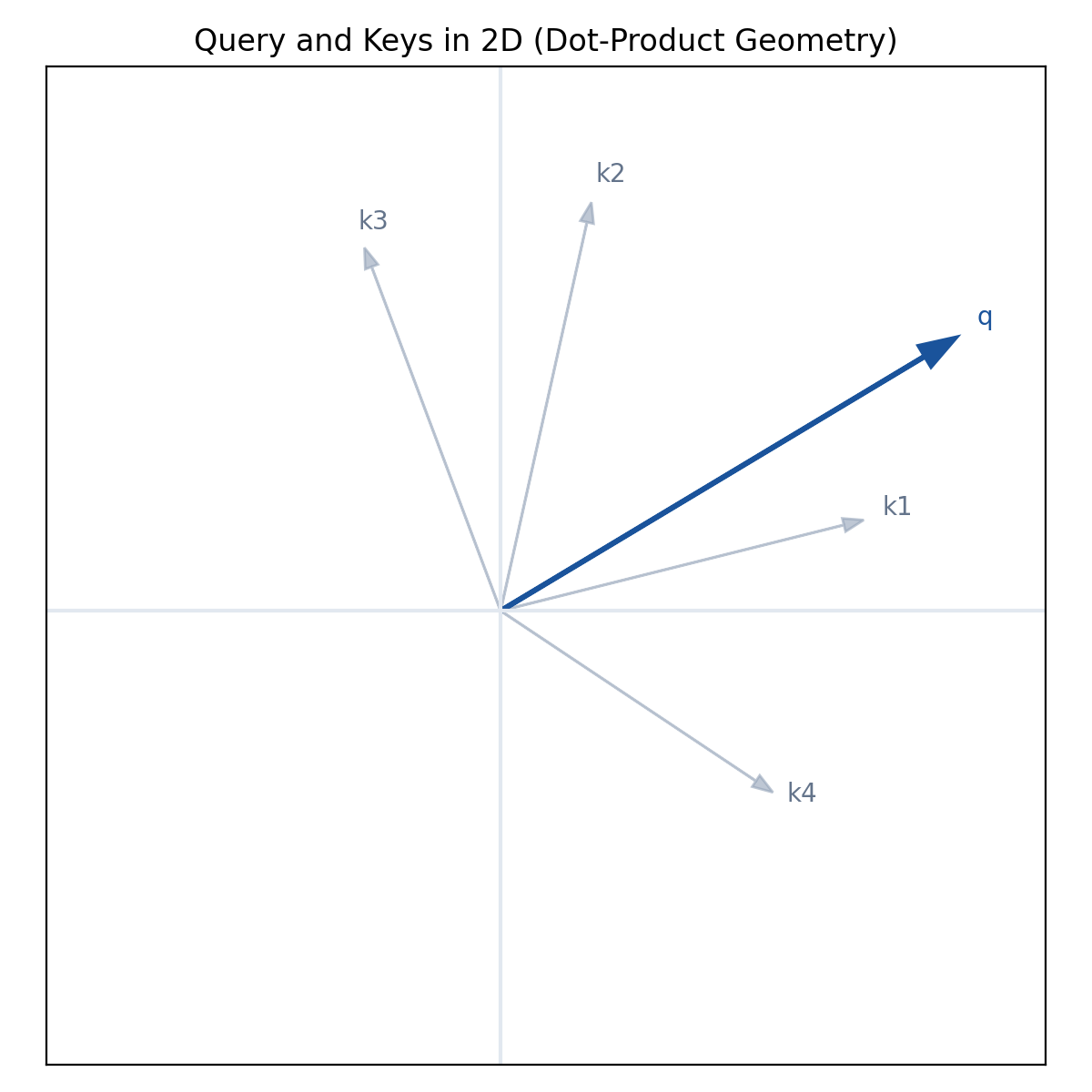
The attention output at position is a weighted average of values , where weights are determined by the similarity between and . In practice, the similarity is a dot product or a scaled dot product. Because the softmax is exponential, small changes in dot products can cause large shifts in weight allocation. Thus, the statistical distribution of dot products is not an implementation detail—it shapes attention behavior.
Multi-head attention is often introduced as “multiple subspaces.” A more precise mental model is: each head imposes its own kernel, with its own learned projections and statistics, on the sequence. As head count changes, the model changes how much representation capacity each head receives and how many distinct kernels can be mixed downstream.
In short: head scaling changes behavior because it changes the geometry, capacity allocation, and learned specialization of the similarity functions.
Mathematical Formulation
Consider an input sequence with tokens. A single attention head uses linear projections:
where . Here is the per-head dimensionality. The unnormalized attention scores are:
and scaled dot-product attention is:
Why the scale?
Assume entries of and are approximately i.i.d. with zero mean and unit variance. Then for a single pair of tokens:
If and are independent with variance 1, then:
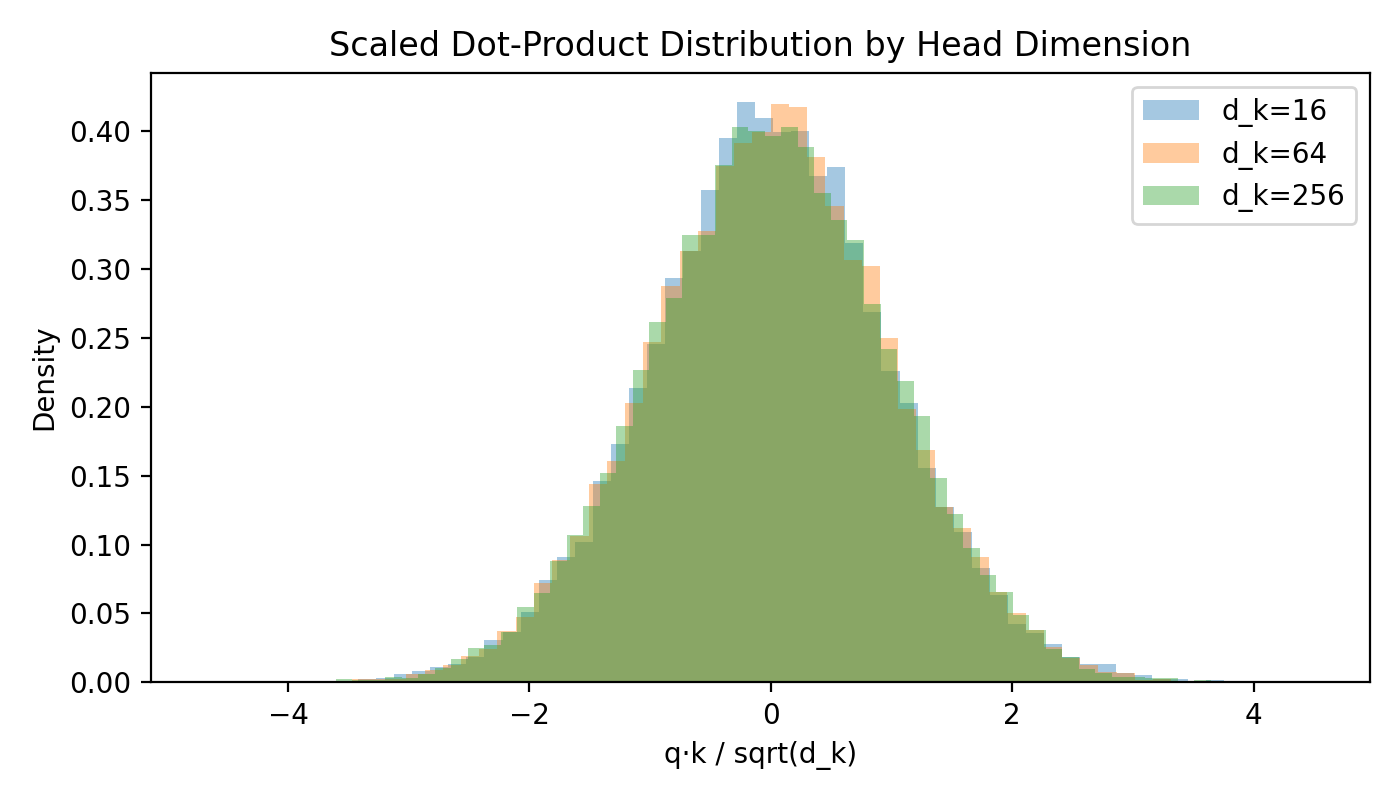
Thus the unscaled dot products grow with . Without scaling, larger yields larger magnitude scores and a sharper softmax, potentially saturating and hurting gradient flow. Scaling by normalizes the variance under these simplifying assumptions:
So the original Transformer scale prevents head dimension from directly driving score variance under the iid model. Real trained heads can still have different effective temperatures because the learned projections, normalization layers, data distribution, and implementation details change the score distribution.
Multi-head attention
Multi-head attention splits the model dimension into heads:
Each head produces:
and the outputs are concatenated and projected:
Scaling the number of heads implies shrinking per-head dimension \(d_k\) if is fixed. That changes capacity allocation even though the scaled dot-product formula normalizes the simplest variance term.
Head Scaling Effects
Head scaling typically means increasing while keeping fixed. This reduces , which has several consequences.
1) Score distribution and softmax sharpness
If shrinks, the variance of unscaled dot products shrinks:
After scaling by , the iid variance is normalized to 1, but the distributional shape can still change. In small , dot products are sums of fewer terms and can show more variability in tail events when projections are learned and inputs are structured. In practice, this can lead to either:
- more peaky distributions if a few dimensions align strongly, or
- more uniform attention if projections are weak.
These two effects can both happen depending on the learned projections. Smaller often yields more head-to-head diversity and more specialized behavior, but that is an empirical/training outcome rather than a direct consequence of the scale factor alone.
2) Effective rank and expressivity
The attention matrix for a head is:
Even if is full rank, the softmax tends to produce low-rank-like structure because it concentrates mass. As increases, each head produces a smaller projection but there are more attention matrices. The combined output can be seen as a mixture of low-rank kernels. Increasing heads increases the mixture count while decreasing each kernel’s embedding dimension.
This mirrors the tradeoff in mixture models: more components, less capacity per component.
3) Geometric interpretation
Consider the normalized similarity:
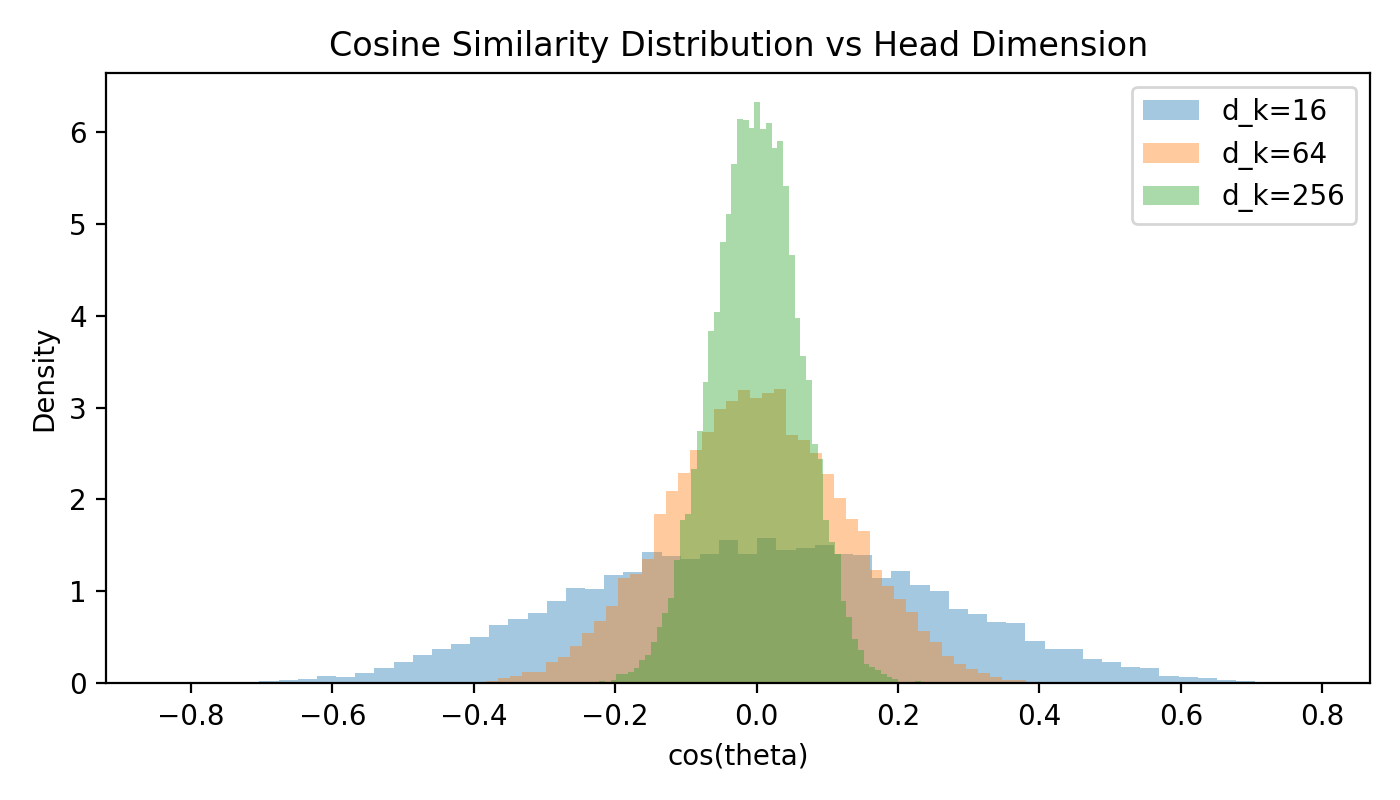
When is large, random vectors concentrate around orthogonality, and cosine similarities are tightly distributed around 0. When is small, cosine similarities are more spread, making it easier for random alignments to produce high similarity. This affects the baseline probability of attention to unrelated tokens.
Thus, head scaling changes the signal-to-noise ratio of similarity measures.
4) Gradient and optimization dynamics
Attention output is:
The gradient depends strongly on softmax sharpness. If attention is too sharp, gradients vanish for non-selected tokens; if too flat, gradients are diffuse and weak. Smaller (with more heads) can shift heads into either of these regimes depending on learned scale. In practice, models often learn per-head scaling or use techniques like RMSNorm/LayerNorm to stabilize.
5) Why “scaling heads” changes behavior
Combining the above:
- More heads → smaller \(d_k\) → more kernels and less capacity per kernel
- Fewer heads → larger \(d_k\) → fewer kernels and more capacity per kernel
Hence, scaling head count changes what attention “looks like” (more diverse patterns) and how it behaves during training (different gradient regimes).
Practical Implications
1) Specialization vs. generalization
Empirically, increasing head count tends to produce more specialized heads: some attend to syntax, some to positional patterns, others to semantic matching. But this comes at the cost of reduced per-head capacity. If becomes too small, each head may be underpowered for capturing complex patterns. This explains why simply increasing heads does not always improve performance.
2) Head dimension as temperature control
Although the scaling is fixed, the learned projections can amplify or suppress the effective temperature. Per-head dimension still matters because it sets the amount of feature capacity available to each kernel. Smaller heads can lead to brittle or noisy attention maps if the task requires richer comparisons than the head can represent. If you observe overly diffuse or overly spiky attention, consider adjusting , , normalization, or projection initialization.
3) Distributional effects in large models
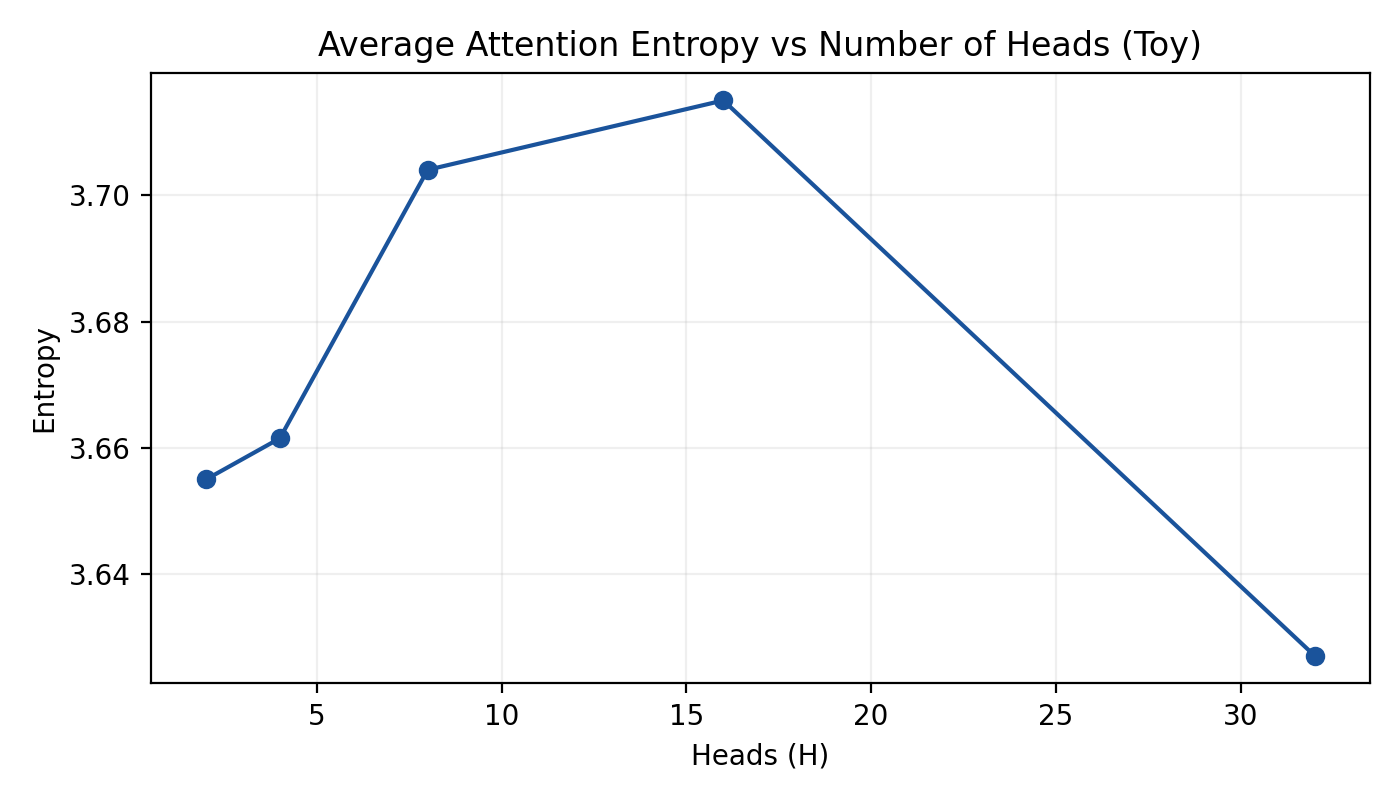
In large-scale models, attention maps are often analyzed in aggregate. But head scaling alters the distribution of attention entropy across heads. For instance, with many heads, entropy variance increases: some heads become extremely sparse while others are diffuse. This can be good (diversity) or bad (instability), depending on the task and training regime.
4) Compute tradeoffs
Computational cost of attention is:
But per-head attention uses matrices of size . Increasing head count increases the number of matrix multiplications but keeps total dimensions constant. In practice, kernel fusion and GPU efficiency often favor a moderate number of heads rather than extreme head counts.
5) Interpreting attention maps
If you visualize attention in a model with many heads, you’ll see many seemingly “noisy” heads. This is not necessarily failure—it’s a consequence of smaller and higher variance in similarity. When evaluating head behavior, consider both head count and head dimension.
Visual Aids
The visualizations below are toy simulations and explanatory diagrams, not measurements from a trained production model.
Vector geometry (query vs. keys)
Scaled dot-product distribution by head dimension
Cosine similarity distribution vs. head dimension
Average attention entropy vs number of heads (toy)
Conclusion
Attention is a learned kernel whose statistics govern model behavior. Queries, keys, and values define the geometry, while scaling keeps the simplest dot-product variance under control. Head count changes the number of learned kernels and the capacity available to each one, which then affects specialization, attention entropy, gradient dynamics, and runtime efficiency.
For practitioners, the takeaway is clear: head count and head dimension are not cosmetic hyperparameters. They shape the attention landscape, impacting both interpretability and performance. Understanding these effects allows more informed scaling decisions and better diagnosis of model behavior in practice.
References
- Vaswani et al. *Attention Is All You Need*. NeurIPS, 2017.
- Choromanski et al. *Rethinking Attention with Performers*. ICLR, 2021.
- Jain and Wallace. *Attention is not Explanation*. NAACL, 2019.
- Xiong et al. *On Layer Normalization in the Transformer Architecture*. ICML, 2020.
- Press et al. *Train Short, Test Long: Attention with Linear Biases Enables Input Length Extrapolation*. ICLR, 2022.
---